◆Purpose of Life Liberation Studies and the Existence of Life Points
Life Liberation Studies is a thought system of life and liberation. What is liberating life from in the first place? Liberate and to what? In a nutshell, it is “freedom. In a word: freedom.
Free will and fatalism” and to move toward “a way of life that balances free will and fatalism.The purpose of life liberation is to liberate us from the “conflict between free will and fatalism.
Then, what is the “conflict between free will and fatalism,” the state we want to liberate? Free Will
will is the belief in the feeling that you are in control of your life. On the other hand fatalism is a belief in the sense that your life is already predetermined and that your daily life is Your life is predetermined, and your daily life is merely following a predetermined destiny. The two seem to be at odds when talking about life.
When we talk about life, the two seem to be at odds with each other. If you can say with certainty, “This life is my choice,” then you are 100% free-willed.
I am living according to my destiny. If you can say, “I live according to my destiny,” you are a 100% fatalist. I dare to write about the two extremes.
I dare to write about the two extremes. In reality, it is impossible to categorize either one or the other. “Birth and upbringing are I am a fatalist when it comes to my birth and upbringing, and a free-willist when it comes to who I am now. And when it comes to death, I am a fatalist.
In death, I want to be a fatalist about my body, but a free-willer about my mind.
This is how the two opposing theories are mixed in the field of life. In many cases, people treat undesirable life with fatalism. They soften regrets and justify giving up. And they try to treat desirable lives free will theory. They try to inspire challenges and link success with self-actualization.
challenges, or to connect success with self-actualization.
In any case, in life, free will is used to eliminate fatalism, and fatalism to eliminate free will.
free will. In any case, in life, we use free will to eliminate fatalism and fatalism to eliminate free will because we feel they are water and oil to begin with. In life liberation studies, however, free will and fatalism are not in conflict.
And fatalism are not in opposition to each other, but rather they are a set of two in a close relationship. However, they are not to be interpreted as opposites.
But we do not see them as mixtures, but as points of contact that are compatible with each other. Self
There is only one way to choose one’s destiny by one’s own choice, one way to connect one’s will to what seems to be one’s destiny.
There is only one way to connect the two. There is a way of life in which both are possible at the same time. In this book, we call it the life point. In this book, we call it a life point.
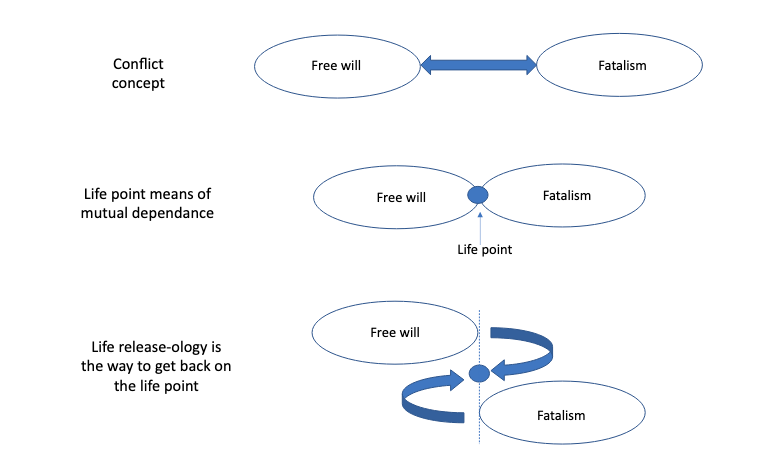
There is a point at which “you voluntarily accept your destiny in life” and “the life you voluntarily choose to call your destiny There is a point at which “you voluntarily accept your life destiny” and “the life you willingly choose to call your life is your destiny” can be simultaneously established. The life point leads you to a “yes” on the life-repeat intention. The life point leads you to a “yes” on the life-repeat intention. Unfortunately, the life point, which is the central point of this life liberation study, is not felt without a broad and deep awareness of life. Unfortunately, the life point, the central point of this life liberation study, cannot be sensed without a broad and deep awareness of life. As the central task of Life Liberation Studies, we will approach the life point from three perspectives. The central task of Life Liberation Studies is to approach the life point from three perspectives.
1) Make the existence of the life point visible.
2) Talk about the meaning of the life point from the world that can be seen by standing there.
3) Present a way to correct the misalignment from the current way of life and the life point.
Principle:.
The Yin-Yang philosophy explains all things in the universe by treating all things as a pair of Yin and Yang. The Yin-Yang philosophy is a Chinese concept that dates back to the 8th century B.C. to the 3rd century B.C. It is said that the Yin-Yang philosophy emerged in China during the Spring and Autumn and Warring States Periods from approximately the 8th century B.C. to the 3rd century B.C.
It is said to have emerged during the Spring and Autumn and Warring States Periods of China, roughly from the 8th century B.C. to the 3rd century B.C., but the exact date is unknown. However, the yin-yang yin-yang diagrams, which symbolize the idea, are still in use today. I am sure everyone has seen it at least once. I have a T-shirt with the yin-yang chart printed on it. Perhaps it is the artistic appeal rather than the semantic appeal that makes it so popular among so many people around the world.
In Life Liberation Studies, we use Yin-Yang philosophy as a thinking tool to approach the invisible life point. Life Liberation Studies uses Yin-Yang philosophy as a thinking tool to approach the invisible life point. To do this, it is necessary to refine Yin-Yang philosophy as a tool. This is the version of Yin-Yang thought.
This is a version of Yin-Yang Thought. If the old Yin-Yang philosophy is version 1.0, the new Yin-Yang philosophy is version 2.0.
From Yin-Yang 1.0 to Yin-Yang 2.0
The theory of Yin-Yang and the Five Elements is said to date back to about 800 B.C. It is one of the ancient Chinese philosophies called the Five Elements Theory. It is one of the ancient Chinese philosophies called the Five Elements Theory. It is a way of thinking that explains all things in the universe, consisting of the Yin-Yang philosophy and the Five Elements theory.
First, the Five Elements Theory is based on the idea that all things are created from the five elements of wood, fire, earth, water, and gold. The five elements are also applied to the natural world and the human world based on the five elements of wood, fire, earth, water, and gold. For example, wood is for spring and east, fire is for summer and south, and earth is for summer and south. For example, wood is in spring, east; fire is in summer, south; earth is in the center, black; gold is in autumn, black; water is in winter, north; and so on. The five elements form a pentagon.
The pentagon of five elements is a cyclical diagram of the compatibility of the five elements, and the pentagram of five elements is a five-pointed star indicating the opposition of each of the two elements. The pentagram of five items is a cyclical diagram of the compatibility of the five elements.
When the concept of yin-yang is added to this, the variations increase. In particular, the yin-yang balance between the two items (10:0) and the yin-yang balance between the two items (10:0). The degree of yin and yang between the two items (from 10:0 to 5:5, and then 0:10), the world changes and the meaning of the next world is the meaning of the next world. The meaning of the world and the next world can be thought of as changing. This was also an important selection criterion when divination and politics were undifferentiated and politics were not yet fully separated. Yin-yang and the Five Elements are two different things, but by uniting them, they were able to explain the complexity of the world more The taiji diagram, however, is not the only one that has been used in the literature. However, the taiji diagram is not documented until around 1,000 AD, which means that it is not known to have been created until around the year 1,000 AD.
The Taiji map, however, was not confirmed in literature until around 1,000 AD, which is quite a while later. It has been about 1,000 years since then. It has become such an icon that it is even used as a pattern on T-shirts. It is a very old icon.
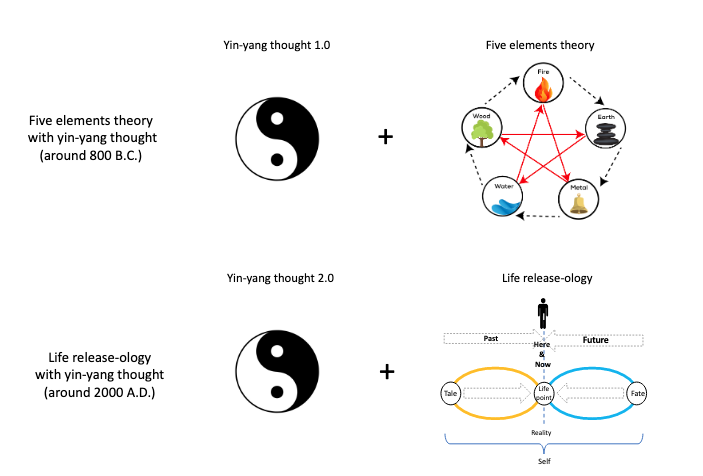
Now, after 2000 years of the lunar calendar, we are using Yin-Yang philosophy as a new tool from a new perspective. Life Liberation Studies is to utilize Yin-Yang philosophy as a new tool from a new perspective. Yin-Yang Thought 2.0 has been upgraded from five major perspectives. The role of Yin-Yang Thought, the initial setting, and the final setting.
These are the role of thought, the initial setting, the final setting, the overall energy, and the dynamic structure. The original 1.0 and The original 1.0 is explained in contrast to Yin-Yang Thought 2.0, so that we can understand not only its characteristics, but also the possibilities and challenges that Yin-Yang Thought has (see 3.0). The possibilities and challenges of Yin-Yang philosophy (areas awaiting resolution in 3.0) will also be touched upon.